Showing posts with label Volkswagen. Show all posts

Monday, May 3, 2021

2021 Q1 Sales by OEM


Looking at the Q1 2021 sales by Automotive Group, we have:


PHEV+BEV


If we gather plugin sales by Automotive Groups, Tesla ended the first quarter of the year in the lead, with 16% share, 3% less than a year ago, which nevertheless is still a small feat all by itself, considering the intensive diversification process that the EV world is now having, 16% is still significant.

Tesla's current domination is however being threatened by the Volkswagen Group the rise and rise of SAIC, that jumped from #9 in Q1 2020, to the current 2nd spot, with its share jumping from 4% a year ago, to the current 13%.

Although most of this growth has to do with the Wuling Mini EV success story, the truth is that SAIC itself is also benefiting from the export efforts made through MG (it is the only Chinese EV brand that sells in volume outside its home country), with leading roles in the EV movement in diverse geographies, from Latin America to Australia, passing by Israel and other Middle Eastern markets, and as these EV markets grow, so too will MG  (and SAIC).

Although being surpassed by SAIC, the Volkswagen Group reduced its distance to the leader from 6% (19% vs 13% in Q1 2020), to the current 4% (16% vs 12%), so not all is lost for the German conglomerate, in its goal to discuss the global leadership, but what has changed in the last 12 months is that Tesla doesn't have just one competitor (VW Group) trying to catch it, but two (VWG and SAIC).

Will this mean that Tesla will lose the 2021 title? Despite an expected strong second half of the year for the VW Group, I believe Tesla will still end the year in the lead, but for 2022...All bets are on.

The BMW Group ended the first quarter of the year in the 4th place, improving on the #5 of 2020, benefiting from the implosion of the Renault-Nissan Alliance (a year ago, the Alliance had 11% share, now it has 5%...) and the popularity of its PHEV lineup. 

We now have a new face on this Top 5, with Stellantis rising to 5th, with 6% share, thanks to an extensive lineup, spreaded through its 205 brands, and with the #4 BMW Group just 11.000 units ahead, we could see it run for the 4th spot soon.

Regarding the Q1 2020 ranking, we witness the disappearance of the Hyundai-Kia Group, that has seen its share drop by half, from 8% a year ago, to the current 4%, so those Hyundai Ioniq 5 and Kia EV6 are badly needed to change the fortunes of the Korean group.


BEV


Looking only at BEVs, Tesla is comfortable in the lead, with 25% share, but has lost 4% share regarding the same period of last year, but the fact that 1 in 4 BEVs sold in the World belongs to Tesla is a feat in itself, considering the current diversification process.

The Silver medal is in the hands of the 2020 Silver medalist, SAIC, with the Chinese maker jumping its share by 6%, to the current 17%, not only leaving the 3rd placed Volkswagen Group in the dust (they ended 2020 separated by just 16.000 units), but they are now starting to see Tesla's rear more clearly.

The self-registering stunt of late last year by the Volkswagen Group is now having its payback, with the first two months of the year being registration low points, with March helping it to recover a bit, but it wasn't enough to recover the 11% share that the German conglomerate had both in Q1 2020 and by the end of last year.

Will we see it recover significantly in Q2?

Just outside the podium we have BYD, with 5% share, with the Chinese carmaker rising one spot regarding 2020, not because it has increased its share (it was actually down from 6% to the current 5%), but because of the Renault-Nissan implosion, with the Alliance now having 4% share, a far cry from the 13%(!) it had 12 months ago...

Like in the PHEV+BEV ranking, Stellantis shows up in the Top 5 BEV ranking for the first time, in 5th, with 5% share, but despite being just 3.000 units behind the #4 BYD, do not expect it to surpass the Chinese maker anytime soon, as BYD is now set to increase deliveries significantly, now that all its BEV lineup has transitioned to the new LFP batteries.

Comparing with the BEV+PHEV table, the big defeated is the BMW Group, that due to its heavy reliance on PHEVs, it disappears from the Top 5, being replaced by the more BEV-friendly BYD.

Thursday, February 4, 2021

2020 Sales by OEM


Looking at the 2020 sales by Automotive Group, we have:


PHEV+BEV


If we gather plugin sales by Automotive Groups, Tesla ended the year ahead, with 16% share, 1% less than a year ago, which nevertheless is still a small feat all by itself, considering the intensive diversification process that the EV niche is now having, could have eroded more significantly its market share.

Tesla's current domination is however being threatened by the Volkswagen Group, that jumped from 6th in 2019 to the current 2nd spot, with its share jumping from 6% in 2019, to the current 13%. 

More importantly, the German conglomerate reduced its distance to the leader from 227.000 units in 2019 (368k vs 141k), to the current 78.000...Inclusively, the VW Group outsold Tesla in the last quarter of the year, by registering some 191.000 units, while the Californian maker had some 183.000 deliveries.

Will this mean that VW will beat Tesla in 2021? I think it will be closer than this year, but i believe Tesla will still have the upper hand, but for 2022...All bets are on.

In 3rd place we now have Shanghai Auto, that shooted from #7 in 2019, to the Bronze medal, having seen its share jump from 6% last year to the current 9%.

But unlike Volkswagen, that had been stable at the runner-up spot since the beggining of the year, by the end of Q3 2020, the Chinese Group was still outside the Top 5, but thanks to an amazing Q4, where it had an incredible 162.000 units, it jumped to the last place of the podium, this result was much due to the thundering success of the Wuling Mini EV, that was responsible for 44% of all of SAIC's registrations. If things go on like this for the Shanghai maker in 2021, then it could become a sort of dark horse and get in the way of the much announced Tesla vs Volkswagen duel. 

Regardless of what will happen in 2021, the big gainers of 2020 were the Volkswagen Group and SAIC, that counted together, gained 10% share this year.

Both the #4 Renault-Nissan Alliance and the #5 BMW Group lost 1% share regarding last year, but while the German OEM repeated the 5th spot of 2019, the Alliance lost one spot regarding the previous year, unable to resist the rise of SAIC.

Regarding the Q3 2020 ranking, we witness the disappearance of the Hyundai-Kia Group, that dropped from #4 then, to #6, despite record sales.


BEV


Looking only at BEVs, Tesla repeated the 2019 title, with 23% share, the same score it had in the previous year, a small feat considering the current diversification process.

The Silver medal changed hands a few times this year, first we had the Renault Nissan Alliance in the runner-up spot, but on Q3 the VW Group took Silver, only to lose the 2nd spot on the last quarter of the year to SAIC, that thanks to the success of its Wuling Mini EV, it came out of the Top 5 into #3 in Q3, having surpassed the German conglomerate in the last quarter.

Still, it was a positive year for the Volkswagen Group, as it jumped from 6th in 2019, with just 5% share, to the last place of the podium, with 11% share.

Same story for SAIC, that jumped from #5 in 2019, with 6% share, to the runner-up spot, with 11% share, confirming these two Automotive Groups (SAIC and VW Group) as the winners of the year, as these two counted together earned 11% share in 2020, and the 22% of both come close to the 23% of the leader Tesla.

The Renault-Nissan Alliance was #4, with 8% share, which, funny enough, are exactly the same scores that the Alliance had in 2019.

The same can't be said regarding BYD, that was down from #3 and 9% share in 2019, to the current 5th spot and just 6%, although the Chinese Group has been recovering lately, climbing to #5 in the last quarter of the year.

Comparing with the BEV+PHEV table, the big defeated is the BMW Group, that due to its heavy reliance on PHEVs, disappears from the Top 5, while BYD replaces it.

Tuesday, September 1, 2020

Milestone of the Month: The Million unit OEMs


There are only 2 OEMs that have surpassed that milestone, both happening this year:

Tesla got there around last April;

The Renault-Nissan Alliance reached the 1 million mark a month later, in May.

And who will be next?

Well, BYD and the VW Group are the main candidates, but both shouldn't be able to get there this year, but expect at least one of them to get there by Q1 2021.


Monday, August 31, 2020

OEMs growth - July 2020

 The new Volkswagen ID.3


If the plugin market as a whole grew 76% in July, in that period, some OEMs grew above average, so this post mentions who was in the fast lane, last month.

Average in July: +76% growth YoY.

Fastest growers:

#1 - PSA (+2.477% YoY);

#2 - Ford Group (628%);

#3 - Volvo Group (360%);

#4 - Daimler (351%);

#5 - VW Group (268%).

For further information, Hyundai-Kia was up 91% YoY and Tesla 49%.

Of course, this simplistic approach is skewed to help smaller OEMs, because if you sold 2 units instead of 1, it means a 100% growth, hence the success of the Top 3 OEMs.

So the best approach is to look at total volume, and here, the OEMs that grew more regarding July 2019, volume wise, are:

#1 - VW Group (24.909);

#2 - Daimler (11.534);

#3 - Tesla (10.816).

If the first spot of the Volkswagen Group can surprise some, if you think about the sales uptick that the German Conglomerate had in the past year, it should come as no surprise, as the sheer scale of the Group means that a couple percent of electrification translates into several thousand units.

The real surprise, including for me, is the second place of the Daimler Group (Mercedes + Smart), that just managed to overcome Tesla, mostly thanks to a surge in sales of the Smart brand, as well as the ramp up of the Mercedes PHEVs and even the EQC has started to be delivered in decent volumes.

Finally, Tesla. And a disclaimer. Because this is the first month of the quarter, one shouldn't read too much into these numbers, as the previous normal quarters (Q4 2019; Q1 2020) saw Tesla increasing the seasonality of sales, with lower than average numbers in the first two months, and then an end of quarter month with higher than usual deliveries, so i wouldn't be surprised if the same happened again this quarter.


Monday, August 3, 2020

H1 2020 sales by OEM

Looking at the 2020 sales by Automotive Group, we have:


PHEV+BEV


If we gather plugin sales by Automotive Groups, Tesla is ahead, with 19% share, followed by the rising Volkswagen Group (13%), that increased the distance to the Renault-Nissan Alliance, that lost 2% share regarding the first quarter of this year, but it is still above the 8% of last year. 

Both the #4 BMW Group and the #5 Hyundai-Kia kept their positions and both lost 1% share regarding three months ago, now having 7% share, but the balance is still positive for the Korean OEM, as they ended 2019 with 6% share.


What catches our eyes in this Top 5 is the absence of Chinese OEMs, last year we had two (BYD and BAIC), expect these OEMs to rebound in a big way in the second half of the year.


BEV


Looking only at BEVs, Tesla lost 1% share regarding Q1, but it is still 5% above the 2019 result, while the #2 Renault Nissan Alliance lost a significant amount of share in this second quarter, dropping from 13% in Q1, to the current 10%, and although is it still better than the 2019 final score (8% share), it has seen the Volkswagen Group is getting really close, now less than 1.000 units behind, although the German OEM has also lost 1% share regarding Q1, the current 10% share is double what VW Group had in 2019.

Expect the German OEM to climb to the Second Spot soon, possibly by end of Q3.


BYD is also on the rise, climbing one position to #4, while increasing its QoQ share by 1%, to 7%, but despite this recovery, the Chinese OEM is still behind last year result of 9% share.

Comparing with the BEV+PHEV table, the big defeated is the BMW Group, that due to its heavy reliance on PHEVs, disappears from the Top 5, while comparing with last year Top 5, the Chinese BAIC and SAIC are left out, but expect SAIC to rebound soon, as the Shanghai maker has recently increased its sales (and share).


Friday, May 22, 2020

China April 2020

EV Sales: China February 2020
BYD Qin Pro EV


BYD Qin Best Seller in April

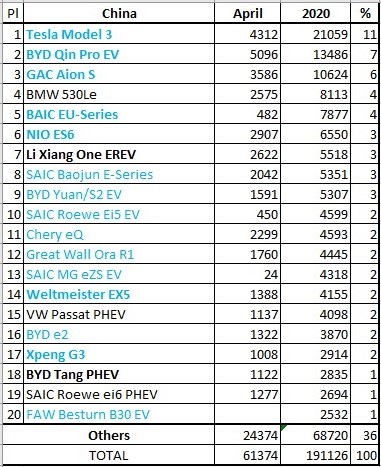
Plugin sales continue to recover in China, being down 29% YoY in April, the smallest drop this year, to close to over 61,000 units.

It is expected that this recovery will develop in the coming months, with the second half of the year probably seeing positive months, and maybe (fingers crossed!) by the end of 2020, we could see this market go back in black.

For now, the overall market is recovering faster, having dropped just 3% last month, and as a consequence, April's PEV share was just 4% (2.9% BEV), keeping the 2020 share at 4.2% (3.3% BEV), a step below from the 5.5% of 2019, hopefully the second half of the year will bring the possibility to beat last year's score.

For once, PHEVs resisted better than BEVs, leading to a 28% vs 72% breakdown between both powertrain technologies in April, and dragging pure electrics down 2% in its 2020 share, now at 77%.

Looking at April Best Sellers, it's Startup Month Edition, with two models from local startups (NIO ES6 and Li Xiang One) showing up, while the young adult Tesla also contributes to the picture, with the Model 3, and the NIO-dusted Aion S, from GAC, makes an appearance, in 3rd.

Here’s April Top 5 Best Selling models individual performance:


#1 – BYD Qin Pro EV

The maker’s reply to the GAC Aion S and BAIC EU-Series has won its first Best Seller trophy last month, thanks to 5,096 units, it seems BYD is betting on its electric sedan to ramp up and stay among the podium Best Sellers, if production capacity is not a problem, demand could end up being an issue, after all, the GAC Aion S is cheaper AND has better specs (59 kWh battery and 510 NEDC electric range for the Aion, 53kWh and 421 kms for the Qin).


#2 – Tesla Model 3

The poster child for electric mobility hit 4,312 units (including imports), being relegated to the runner-up spot for the first time this year, but fear not, this has more to do with temporary price policies (buyers knew that Tesla would lower in a few days the price of its SR+ version) than demand, or production issues, Tesla made some 10,000 units during April, so with the price effectively dropping below 300,000 RMB in May, expect a smashing month next month, with around 16,000 units being delivered (6,000 from April + 10,000 made in May), with the sports sedan returning to the leadership.


#3 – GAC Aion S

GAC’s sleek sedan retuned to the podium, having registered 3,586 units, a new year best, and while the Aion S is still far from the 8,460 units of last December, the ramp up continues and should reach cruise speed some time in the summer. One of the most competitive domestic EV’s on the market, the Aion S is sure to continue a regular in this Top 5, being a strong candidate to the medals positions.


#4 – NIO ES6

Another Top 5 presence for NIO, with the Midsize SUV scoring a record performance, thanks to 2,907 deliveries. Facing an uphill battle, after all, marrying “Premium” and “Chinese” in one EV-only brand is no easy task, the fact is that NIO products and concept are intriguing and add something new to the current EV landscape, not only they have battery swap stations, but they also increase regularly their models battery capacity, from the initial 74 kWh, back in 2018, to 80 kWh in 2019, and now in 2020, they have launched a 100 kWh option. Even better, the brand allows existing owners to upgrade their current batteries to the 100 kWh pack, for little over $5,000! The ES6 is the current best seller, but in a few months, the Model Y-like (and 100kWh battery-equipped) EC6 crossover will land, possibly stealing the thunder from its larger, taller, sibling ES6.


#5 – Li Xiang One EREV

A startup that only started to deliver units last December, Li Xiang is fast becoming a relevant player in the market, winning its first Top 5 presence in April, thanks to a record 2,622 units, an amazing performance, especially when we consider that this is a 5-meter, 7-seater, full-size SUV. Using an original strategy when it comes to powertrain, being one of the few Extended Range Electric Vehicles on the market, it adds to the 41 kWh battery with fast-charging capabilities, a 1.2 liter gasoline engine that works as a range enxtender. With such a fast production ramp up, there shouldn't be any issues on that side, the question should be how much demand there will be for such unique proposition.


Chinese EV maker Lixiang says it has delivered more than 4,500 ...
Li Xiang ONE

Looking at the 2020 ranking, there were some significant changes, with the GAC Aion S climbing one position to 3rd, while the BMW 530Le followed it, up to #4.

The local EV Startups are shining, with the NIO ES6 jumping 3 spots, to #6, while the Li Xiang One did even better, shooting 4 positions, to #7, with the Weltmeister EX5 (1,388 units, new year best) in #14, the XPeng G3 joining the table, in #17 and the Hozon Neta N01 in #21, just 204 units behind the #20 position, we could even have here 5 EV Startup models soon!

In other news, in the City Ev category, the tiny Baojun E-Series went up to #8, thanks to a year best 2,042 units, the Chery eQ (2,299 units, year best) was up to #11, while the Great Wall Ora R1 also jumped positions, now at #12, thanks to 1,760 units, which was, you guessed it, a new year best.

The BYD Tang PHEV climbed two positions, to #18, thanks to 1,122 units, a new year best (Do you see a trend here?)

Outside the table, Volkswagen started flexing its muscles, with 5(!) models posting four-digit performances (Tiguan PHEV - 1,035 units; Tayron PHEV - 1,062; Magotan PHEV - 1,377; e-Golf - 2,068; e-Bora - 1,364), allowing the veteran e-Golf hatchback to jump to #22, just 324 units away from the table, so expect it to join the table soon. Add the #15 Passat PHEV (1,137 units), and we have 6 VW's in the four-digits in April...How do you say "The Empire Strikes Back" in Chinese? But more on that below...

Looking at the manufacturers ranking, BYD (18%, up 1%) is in the leadership, with Tesla (12%, down 2%) keeping the runner up spot, while SAIC (10%, down 2%) is 3rd, with the #4 GAC (7%, down 1%) already watching the #5 Volkswagen ( 7%, up 2%) presence behind it. 


In the race for the global EV market supremacy, with Tesla owning North America's EV market and the VW Group (VAG) already beating Tesla in Europe, their domestic markets are in the bag of each, but China is neutral ground for both, and on top of that, it is also the most competitive EV market in the World, with an army of local competitors, and with the Model 3 now being made in China, Tesla took an early lead this year, so despite April's impressive performance, the German Conglomerate currently only has 8% share in the Chinese plugin market, trailing 4% behind Tesla.

But what it lacks in appealing models (insert oldtimer jokes), VAG compensates in its (massive) scale in China, allowing it to offer a plethora of models, including plugins, to local buyers, just to have an idea, Volkswagen offers 3 (three) different plugin hybrid Passats (Made-in-China Passat PHEV, Magotan GTE, Made-in-Germany Passat GTE), so to reduce the distance for Tesla in 2020, it is essential that VAG can pull off a Space Cowboys stunt in China.

With the Tesla Model 3 the most likely winner of this year Best Seller title in China, but without other models that can follow the sports sedan lead, Tesla is now something of a one trick pony in the Middle Kingdom, hence the reason why BYD's full lineup allows it to be 6% ahead of Tesla, and Volkswagen expects to replicate the same strategy to come closer to the American brand.

But the real fun will be in 2021, with the first member of the ID family (ID.4) expected to be made in China by late this year and the Tesla Model Y doing the same in early 2021, while the MiC ID.3 is set to start sometime in 2021, the race will be on between those two, although the local makers probably won't be sitting down too, and at least in their own market, they will be looking to get in the way of the two EV titans.