Showing posts with label Geely. Show all posts

Monday, February 10, 2025

World EV Sales - Full year 2024 (Brands)


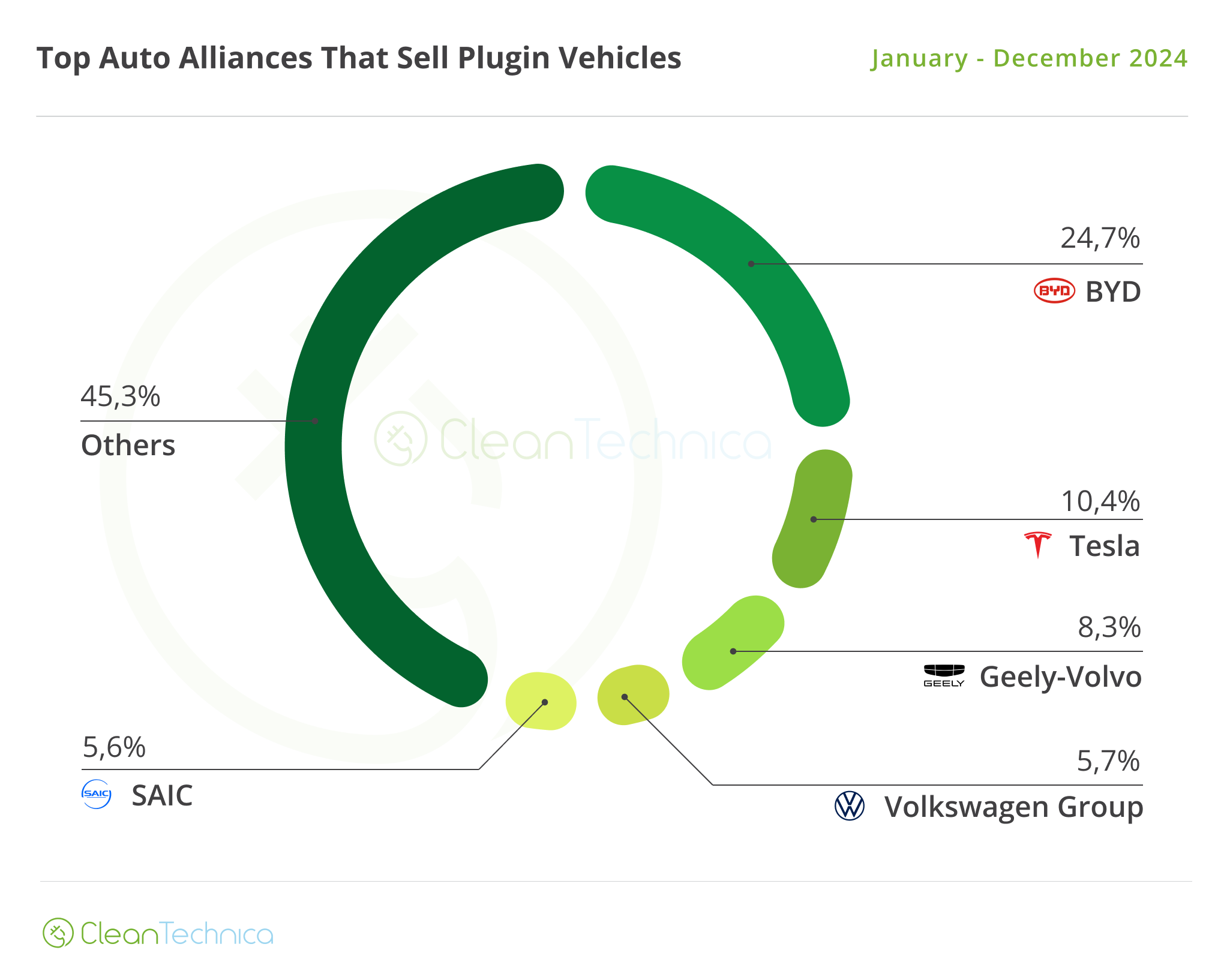
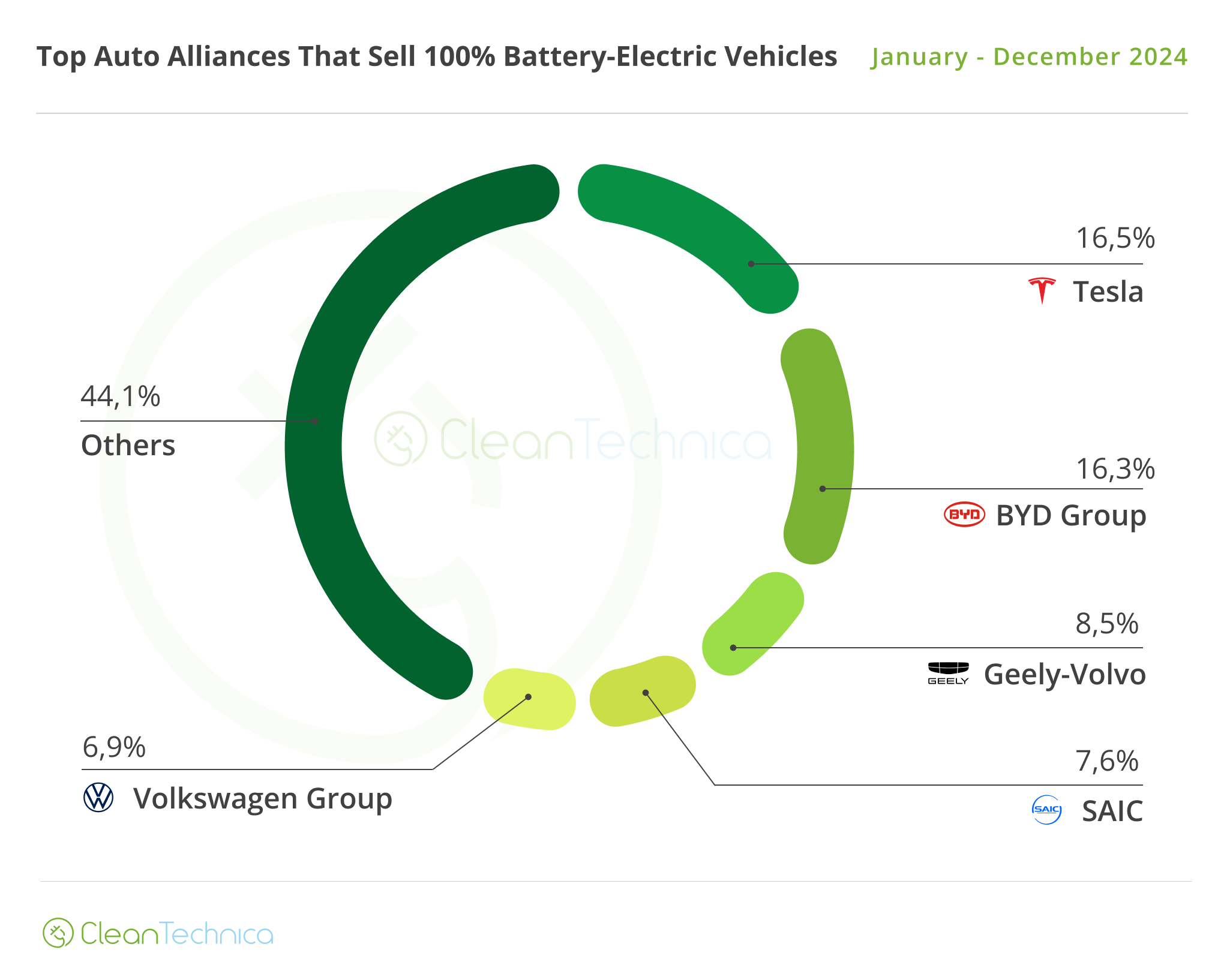
Rising BYD was the best selling EV maker in 2024


Tesla was #2 and Wuling #3


Best Selling legacy brand was BMW(!), in 5th, behind a rising #4 Geely


Looking at 2025, expect BYD to continue rising, Tesla to drop below the 10% mark, but retain the 2nd position, while Geely will go all out and try displace Wuling from the 3rd spot.

Considering the difference in firepower between both brands, not only regarding lineup, but also number of markets where both are present, it is likely that Geely will end the year in 3rd, this being the podium by the end of the year:

1. BYD

2. Tesla

3. Geely


A final note on Toyota, the legacy brand that most progressed in the top 20(!)

Comparing 2023 with 2024, the Japanese car maker jumped from #19 to #14, growing its market share by almost 50%(!), to 1.5%.

And with Toyota apparently being serious in making the new Urban Cruiser crossover a success, it should continue climbing in the table.

(Well, it was about time for Toyota to take the EV game seriously)  

Tuesday, February 4, 2020

2019 sales by OEM


Looking at the 2019 sales by Automotive Group, we have:

PHEV+BEV


If we gather sales by Automotive Groups, Tesla is ahead, with 17% share (Up 5% regarding 2019), thanks to a 122,000 units sales growth regarding 2018, followed by BYD (10%, down 1%), that has seen its sales impacted by the subsidies change in China, and the Renault-Nissan Alliance, that dropped 1% YoY, to 9% share, that suffered from the slowing sales of the Nissan Leaf, with the 2018 podium repeating in 2019. 

The #4 BAIC also dropped 1%, to 7% share (down 2%) repeating last year place, with the #5 BMW Group also keeping the same position as in 2018, but in the case of the German Group, its slight growth rate allowed it to keep the same market share as in the previous year.

The Climber in the ranking was the Volkswagen Group, that in the Year -1 of its Plan to Rule the EV World, it jumped 3 spots, from #9 to #6, surpassing SAIC, Hyundai-Kia and the Geely Group, thanks to a 59,000 units growth regarding 2018, an amazing 70% growth rate, beating even that of Tesla (+50% YoY).

Will the German Group be able to outpace Tesla again in 2020? And in 2021?

Still, despite being surpassed by Volkswagen Group, SAIC, Hyundai-Kia and Geely all grew, with the Korean Group in particular growing at a significant 38% rate. 

Finally, with the demise of most of the smaller Chinese EV makers, Toyota(!) managed to climb to #10, growing 20% YoY, thanks to the start of its Chinese Operations. 


BEV


Looking just at the 1.6 million BEVs, Tesla expanded its lead, doubling the result of #2 BAIC, which was also the runner-up in 2018, while the slowing sales of the Renault-Nissan Alliance dropped it to #4, with BYD becoming the 2019 Bronze medalist, thanks to a 46% growth rate, so although in the BEV+PHEV table BYD has stagnated, in reality, BYD has replaced a significant part of their plugin hybrid sales for pure electric ones.

SAIC benefits from the unexpected success of the Baojun E-Series to climb into #5, the VW Group came out of obscurity straight into #7, while Hyundai-Kia, growing 46% YoY, ended in #6.

Finally, the fast growing GAC ended at #9, and could climb even more in 2020.

Friday, May 3, 2019

Global Sales by Automotive Group - Q1 2019


With the first quarter of the year done, it is time to see how the main PEV Automotive Groups have behaved:


1. BYD Group (71.504, +150%);

2. Tesla (63.000, +105%);

3. Renault-Nissan-Mitsubishi Alliance (60.031, +21%);

4. Geely Group (34.746, +109%);

5. BMW Group (29.208, +5%).


As we can see, the top two makers are really in a league of their own, more than doubling their sales. The Alliance (including JMC) is still close to the other two, but its growth rate is smaller.

Regarding 2018, Geely has jumped 3 spots, to 4th, surpassing its Chinese rivals and a stagnating BMW.


Looking just at BEVs, the ranking goes like this:

1. Tesla (63.000, +105%);

2. Renault-Nissan-Mitsubishi Alliance (46.768, +16%);

3. BYD Group (45.758, +758%);

4. BAIC (26.106, +21%);

5. Hyundai-Kia (19.632, +132%).


In the BEV ranking, Tesla is the expected leader, while BYD BEVs are growing exponentially, surely surpassing the Alliance soon, while the #5 Hyundai-Kia are also on the fast lane.

Sunday, February 3, 2019

2018 Global Sales by OEM (Updated)

Looking at the 2018 sales by Automotive Group, we have:


Regarding the previous post, both Tesla (12%) and BYD (11%) maintained their lead, but last year winner, the #3 Renault-Nissan Alliance (9%, -1%), lost a bit more ground, with the rising BAIC (8%, +1%) cutting distances to the podium, having surpassed BMW in November, to reach #4. 

Regarding the remaining OEMs, there is one significant change, with Hyundai-Kia surpassing the almighty VW Group and reaching #8, which says a lot about what is happening right now...


Interestingly, half of the Top 10 belongs to Chinese OEMs, and if we add Tesla to the Disruptors team, Legacy OEMs are a minority in the Top 10. Is this a sign of the New World Order in the automotive industry?

Looking at last year standings, and comparing it with 2018, there are noticeable changes, Tesla jumped from #5 to the leadership, Renault-Nissan dropped from #1 to 3rd, Geely dropped two positions, to #6, SAIC was up two spots to #6, while the Volkswagen was down two spots, to #9.

Highlighting the changing times, we have two new Automotive Groups in the Top 10, with Hyundai-Kia jumping to #8, and Chery reaching #10, kicking out General Motors, now #11, and Toyota (down to #15!) out of the Top 10. 

The Toyota case is particularly worrying, not only because it is one of the largest Automotive OEMs, and in this ranking is only #15, but also because in a fast growing market, it was one of the few (the only?) OEMs to lose sales (-10%) regarding 2017...


BEVs Only

Looking only at BEVs, the ranking would be like this:

1. Tesla (245.240);

2. BAIC (165.369);

3. Renault-Nissan (150.374);

4.  BYD (105.420);

5. Chery (64.897).

The disruption is even more visible here, with only Renault-Nissan on the Top 5, and Tesla winning even more easily.

In fact, if we have  increased this to a Top 10, we would only have another Legacy OEM here, Hyundai-Kia, #7, with 58.990 units.

So, BMW and the VW Group are still too PHEV-based to be considered one of the leading Legacy OEMs. Maybe things will look different in 2020? 

Monday, January 29, 2018

2017 Global Sales by OEM

Related image

The Global December sales post is coming soon, but taking on a reader suggestion, i've decided to post this Top 10 ranking by Automotive Group, the 2017 edition was truly exciting to see unfold, with several OEMs separated by what can only be described as split hairs, which bodes well for the dynamics of the market, with no one truly owning the market. And that's how i like it: "Diversity breeds Competition, Competition breeds Improvement".

Here are the 10 Best Selling OEMs of 2017:

1. Renault-Nissan Alliance (119.195 units)

The addition of Mitsubishi to the lineup masked a soft selling year, mostly due to the sunset-mode of the Nissan Leaf, but with its new version arriving soon, expect The Alliance to continue prospering throughout 2018. reaching between 200k to 250k units in 2018.

2. BYD Group (113.949)

Despite a struggling start, BYD got their act together and even managed to surpass their chronic production constraints, growing 14% regarding 2016. Growth is expected to continue in 2018, but with (even) more aggressive OEMs coming right behind it, it could have its podium place in danger this year...

3. BAIC Group (104.536)

The surprise of the year. Thanks to the EC-Series, the 2017 Best Selling EV, Beijing Auto, which includes Changhe Auto, became the Third largest OEM in the plug-in world, and if we limit just to BEVs, it is the Biggest, overcoming Tesla and the Renault-Nissan Alliance. How high can it go this year? Even it the 2017 growth rate (+126%) is not possible to repeat, i guess 170k units will be a reasonable target for BAIC to beat.

4. Geely Group (103.194)

The Chinese juggernaut, known to have almost as many brands as the Volkswagen Group, profited from the general growth of their plug-in offer (Zhidou, Geely, Volvo, etc...) to post a surprising result of over 103.000 units. With yet another brand addition to the lineup in 2018, with the recent, and irreverent, Lynk & Co starting to make their own PEVs, Geely is set to continue on the growth path throughout 2018.

5. Tesla (103.122)

Despite what some fanboys dream, the American brand is not (yet, at least) taking over the EV world, in fact in 2017 its growth rate (36%) was below what the global PEV market (+58%) had, so in fact, Tesla lost share last year...Expect things to change radically in 2018, with the Model 3 ramp up, with the brand deliveries expected to reach some 250k units by year end, which, it should be said, is no garantee to earn its first Best Selling Maker award, as other OEMs (Read: Chinese ones) are also stepping up dramatically. 

6. BMW Group (103.080)

In a very German way, the Luxury maker said previously it was going to reach 100.000 in 2017, and so it did, making it the Best performing legacy OEM by far. Sure, most are short-range PHEVs, but neverthless, they count here and they helped to Place BMW as the last of the "Big 6" plug-in makers of 2017. With a target of 150.000 PEVs set for 2018, count them in to reach such number, with some units to spare.

7. Volkswagen Group (70.314)

The Volkswagen Group was the Best Seller of the laggards Group B, with 70.000 units, currently struggling with shortage supply of batteries for some models (VW e-Golf, Porsche Panamera PHEV...), and not enough love regarding some other models (VW e-Up!), apart from the e-Golf (30 k in 2018?), do not expect significant growth coming from here, as their eyes are all set in 2019.

8. SAIC Group (56.149)

The smallest of the Chinese "Big 4", it has nevertheless great prostpects for 2018, not only because of the potential of the Wuling E100 (This model alone can reach some 60k in 2018), but Roewe will continue to grow, and with the addition of MG to the plug-in lineup, sales can only go up, maybe even surpassing the 150k of BMW...

9. General Motors (55.188)

It might come as shock to many of the readers, maybe in the same degree as seeing Tesla only in Fifth, but the #9 spot of General Motors is simply explained: Bad management. By concentrating their efforts in North America, they are letting go of the two largest engines of growth, the first is by far China, where they have two models (Buick Velite/Volt & Cadillac CT6 PHEV) with the wrong kind of technology (China is BEV-friendly), both selling poorly, while they have a possible winner (Bolt) still slowly ramping up production in their US factory after more than a year on the market. Which leads us to to the Second Engine of growth (Europe), where GM was greedy while negotiating  the Opel sell to PSA, effectively ending the Ampera-e (Bolt) career in Europe. Actually, the current GM management is akin to the current USA goverment: "America First". The problem for them, is that the America global relevance is getting smaller and smaller every passing day and the world will go on, regardless of what happens there. (And why did i remembered the UK's Brexit?) 

10. Toyota (50.883)

Another surprise, just one model, a plug-in hybrid no less, allows Toyota to close this Top 10, ahead of heavyweights like Hyundai-Kia (41k), or Daimler-Mercedes (37k). Caught on the Fuel Cell delusion, Toyota efectivelly lost the upper-hand it had for years with the hybrid game, and only now is trying to get in the next generation (PEV) game. But do not rule them out, with millions of happy customers running around in their hybrids, their base will be a huge plus point, once they are back in The Game. If they reached #10 with only one model, image what they can do with two or three more...
Thursday, November 2, 2017

Auotomotive Groups - September 2017

Image result for Roewe eRX5
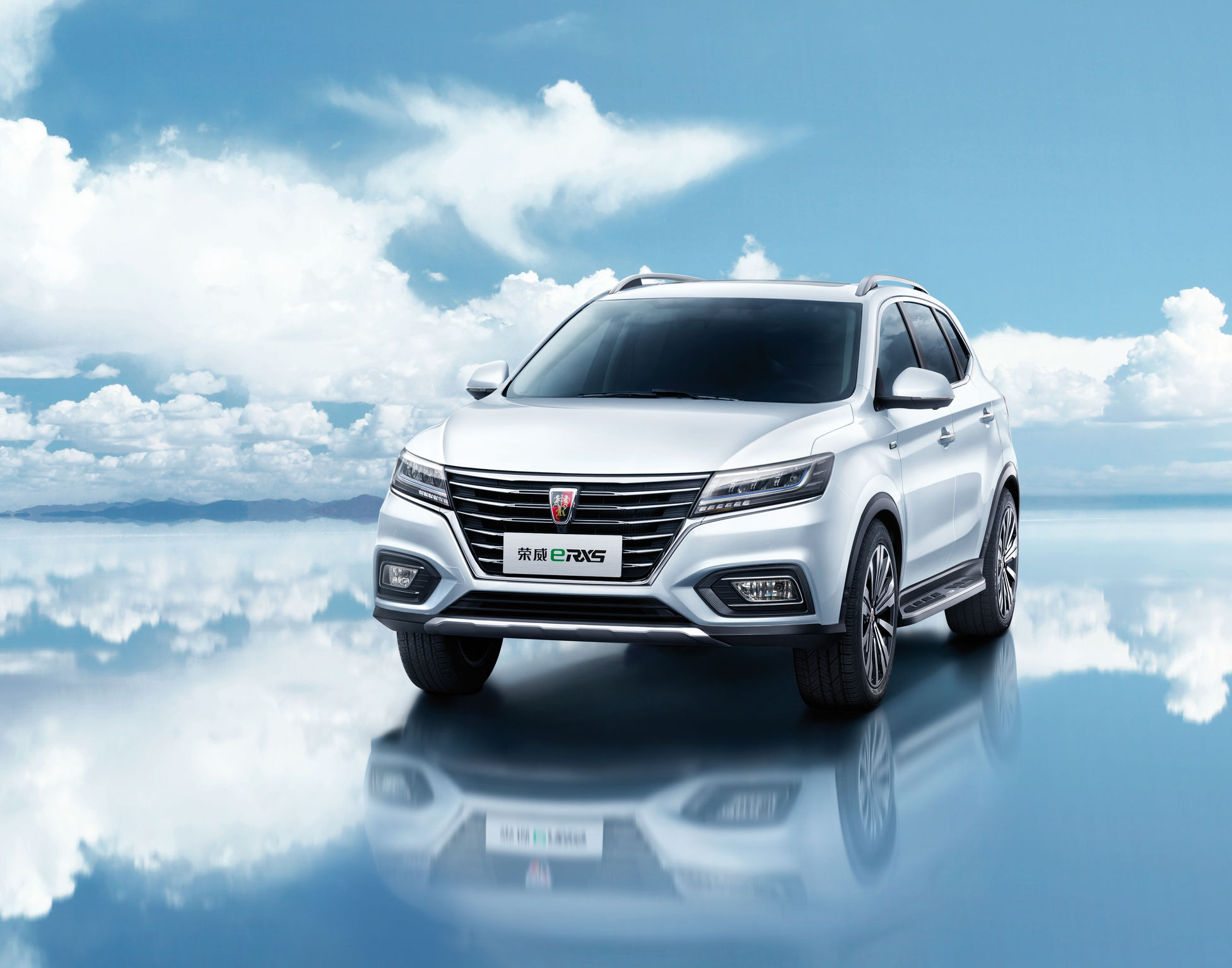
SAIC joins the Top 10, mostly thanks to this model

Automotive Group 
Units % of sales
Renault-Nissan89.24512
Tesla73.22710
BYD Group71.0709
BMW Group
Geely Gr. (w / Zhidou)
68.687
68.494
9
9
BAIC58.7167
Volkswagen Group46.7306
Toyota39.4225
General Motors37.3875
SAIC
Hyundai-Kia
29.434
26.774
4
3

Looking at sales by automotive groups, the Renault-Nissan Alliance, now reinforced with Mitsubishi, is unsurprisingly in the Pole Position, but its share has dropped 2%, to 12% share, no doubt result of the Nissan Leaf generation change, while Tesla remained in Second Place, with a BYD on full charge climbing to Third, at the expense of the BMW Group, down to Fourth.

The 2017 Best Selling OEM seems to be in the hands of the Renault-Nissan-Mitsubishi trifecta, which has  successfully defending its lead over Tesla and BYD, with both OEMs struggling with production constraints.

As for the remaining players, rising star SAIC climbed to Tenth, meaning there are four Chinese OEMs (BYD; BAIC, Geely and SAIC) in the Top 10,  and i would't be surprised if it climbed a couple of positions in the future, as their models are possibly the best value for money PEVs in China.

Looking into 2018, the Renault-Nissan Alliance will receive an important reinforcement, with the new Leaf, possibly adding some 100k-120k units to the current tally, possibly ending the year at 220-250k units.

Tesla has its Model 3 to deliver en masse, a while ago i had predicted some 300k Model 3 deliveries next year, but considering the current state of the Tesla Nation, i believe its best to cut that to 250.000 units, adding some 100k from the Model S & X, and we have Tesla delivering around 350.000 units next year, which would make it the Best Selling OEM of 2018, a first for the Californian.

BYD is set to deliver some 110.000 units this year, a giant setback over the expected 200k for this year. So for 2018, it is complicated to forecast a number, especially because of their production ramp up issues, but i would say that it will be in the 175.000 units ballpark, a number that could put its podium position threatened by a fast growing BAIC.

As for the remaining OEMs, BMW and Geely will try to follow the pace of the aforementioned two, ending at around 150k, while the rest of the competition will be happy to reach 100.000 deliveries in one year.

Wednesday, February 1, 2017

Automotive Groups December 2016

Image result for general motors


Regarding 2015, there were some major changes, BYD jumped ahead of the Renault-Nissan Alliance (Haven't included Mitsubishi yet, as the Japanese brand was only included in October), and has set an ambitious goal of 200.000 units in 2017, while Tesla climbed to Third at the expense of the Volkswagen Group and hopes to reach BYD-level of deliveries this year.

But the 2017 Best Selling OEM title will be a three horse race, as a Renault-Nissan-Mitsubishi Alliance can also reach 200.000 units with relative ease, it's just a matter of producing the Renault Zoe at full speed, update the Nissan Leaf with a 40 kWh battery soon and actively sell the Mitsu Outlander PHEV.

Volkswagen's slow growth (Up only 6% YoY) has made it lose the Third spot and it wasn't surpassed by an ambitious (100.000 units goal for 2017!) BMW Group by just 300 units, so VW better shape up in 2017 and increase sales significantly, or else they will be on the uncomfortable role of also-rans, 2020 and its I.D. disruptive model is still some years away and a lot can/will change until then. 

BAIC is rising from the shadow of BYD and despite only selling half of the Chinese poster-child, it is growing significantly (The EC180 looks like a winner), so it wouldn't be surprising to see it reach 80.000 sales this year, same as the Geely Group, which has seen Volvo grow 50% and most importantly, Geely land with 17.000 units. Two OEMs to follow closely in 2017.

The same can be said about General Motors, growing 54% YoY in 2016 and that's without using the ace up its sleeve (Chevy Bolt). With the Bolt and Volt (Arriving soon to China) charging at full speed, anything less than doubling sales in 2017 will be considered a disappointment. As for the Cadillac CT6 PHEV career, i believe the ELR is a good sales indication...

Automotive Group  Units  % of sales
BYD 102.470 17
Renault-Nissan 86.247 1
Tesla 76.243 100
VW Group 62.480 1
BMW Group 62.157 3
BAIC 46.420 2
Zotye 37.363 15
Geely Group 32.760 3
General Motors 32.700 0
Mitsubishi 32.179 2


Looking at the percentage of plug-in sales of each OEM, besides the obvious case of Tesla, the two brands that have a significant share of EV's are BYD (17%) and Zotye (15%), with the remaining OEMs still having residual percentages, with the highest share of this third pack being the BMW and Geely Groups, both with 3% share. 

General Motors has a lot to improve, as their plug-ins still do not reach 1% of the Group sales, but even so, there are worse OEMs, like Toyota of Fiat-Chrysler... 


Monday, December 26, 2016

Five Exportable EV's from China

Image result for lynk & co geely
2017/8 Lynk & Co: Chinese Plug-in made for Export

Mass exports from Chinese Auto Brands to mature markets have been hampered by Safety and Emission concerns, as well as a general prejudice regarding products coming that country.

BEV's are seen as an opportunity, because the Emission part of the equation is solved from the beginning, while Safety and Design of Chinese cars have been evolving faster than their foreign competitors, reducing the gap, so it won't be long until the best Chinese Electric Cars are head-to-head  with the best mass market EV's.

To date, Chinese EV makers haven't really bothered to export their models, because their domestic is more than enough to absorb all production, but if they did, which would be the more successful? These would be my picks.

Bare in mind that i chose only all-electric cars and eschewed the current Top Best Sellers, this a personal view and others might choose different models.


2016 byd qin ev300 - DOC671707

BYD Qin EV300 - BYD's can be seen something a bit like Chinese Teslas, with Youtube videos showing their Tang SUV's racing BMW X6's and the like, BYD is not only the largest plug-in maker in the World, but also a cool one, a rare commodity among Chinese car makers. Unfortunately, like Tesla, coolness doesn't come cheap, and this Qin EV300 costs 260k Yuan (Price before subsidies), or around 36.000 euros. Did i hear you say: "Yikes, that's a lot of money for a Chinese car!". It is, but then again, you get a lot in return: 300 kms range from a 48 kWh battery, 218 hp, 0-100 kms/h in 7.9s, nice interiors...Think of it as sort of an all-electric Chevrolet Volt and you are not far from the truth. For those that still can't get past the price and don't mind a taxi-like-appliance, BYD offers the e5 300, which is basically the same package and specs, but with a less sexy outfit, for 230k Yuan, or 31.500 eur.


geely-emgrand-ev-2016-015


Geely Emgrand EV - The owner of Volvo joined this year the EV stage with the Emgrand EV, a BYD Qin fighter, that is slightly cheaper (252k Yuan, 34.5k eur), but has also slightly less range (253 kms from a 45 kWh battery),  and despite being no slouch (120 hp, 9.9s 0-100kms/h), is significantly slower. "So, why would people buy this, if the Qin has almost the same price but better specs?" - Some might ask. The short answer is "Volvo". As mentioned before, one of the weak points of Chinese Car Makers is brand cachet, or the lack of it. If BYD has become a known entity among the plug-in niche and can start there their branding, Geely as no cred among EV followers or the general public in developed markets, but add the word "Volvo" to the mix and things start to change, with the most recent Geely models sharing technology with the Swedish brand, Geely can use that card the same way Mercedes did with the Smart brand (Mercedes tech) or Renault with Dacia. That way, customers can say to their friends, neighbors and coworkers: "Yeah, my car came from China, but it's made with Volvo parts"


chery-eq-ev-015

Chery eQ - A consistent seller in China, the funky eQ sells for 160k Yuan (22.000 Euro) before incentives and for that you get a decently equipped and sized city car, with 22kWh battery and 200 kms range, with the only drawback being the weak engine (56 hp, 100 kms/h top speed), at least by First World standards, which might put off people when thinking about some urban freeways. Add a bit more power to the engine and you could have a valuable competitor to the current crop of city EV's, as the Mitsubishi triplets are showing their age, the VW e-Up! is pricey, while the upcoming Smart Forfour ED looks too goofy (What were Smart designers smoking when did this last generation?!?).


zotye-e30-001

Zotye Zhima E30 - An intriguing mash up of BMW i3, Smart Fortwo (Previous generation) and Tesla on the inside, this butch(y) city car, looks quite nice inside and out, but Zotye will have to improve specs to have success on foreign markets, especially considering the (steep) price: 25.000 Euro. Increase the 18 kWh battery size to some 24 kWh, pulling the range north of 200 kms, and place a peppy engine (100 hp should be enough) and this tittle bugger will have specs that match its hip design and make it a success.


baic-ex200-ev-2016-003

BAIC EX200 - Ending this list without a Crossover would be ignoring probably the most significant automotive trend in China and globally, so among the rising number of BEV Crossovers made in China, i have chosen this model, the electric conversion of the Senova X25 best seller. This small Crossover (Think Kia Soul or Renault Captur) is only #19 in the plug-in ranking in China, but right now its sales potential could be hampered by the battery, the 30kWh allows only 200 kms range, if BAIC placed the 41 kWh battery of its EU260 sedan, then range would get a bump to some 250 kms and surely sales would increase significantly, more so if the engine were to be upgraded from the current 70 hp to 90/100 hp. Doing these changes and keeping price at current levels, 207k Yuan (28.500 Euro) before incentives, would transform this model in a real winner on foreign markets, especially considering the only plug-in model in that segment is the much more expensive Kia Soul EV.


Wednesday, July 6, 2016

Top EV Automotive Groups - May 2016


In the beginning of the year, i've published the 2015 EV sales divided by Automotive Groups, let's see how the ranking is after the first five months of 2016.


Sales '16%Total Sales%

Renault-Nissan36.72915328.07422

BYD 34.00814121.6648

VW (VAG)21.852994.3306

Tesla 21.6779130.9249

BMW17.117769.1465

Mitsubishi15.6147150.58010

Geely12.881579.0505

GM10.7295122.5608


Comparing with the 2015 and all-time numbers:

- This year the Renault-Nissan Alliance is still in the leadership, but emerging BYD (14% share now vs 11% in 2015) is becoming increasingly menacing, it looks to be just a question of time until the Chinese Group becomes the Best Selling OEM when it comes to plug-ins;

- Another significant event to those less familiar with EV Sales, is that Tesla is selling as many plug-ins as the whole Volkswagen Group (Including, VW, Audi, Porsche...), although VAG is still new to the game, the fact is that it has lost 2% share regarding last year, while Tesla share has been stable throughout the years, surfing the EV wave at around 9 to 10% share;

- BMW is expanding its plug-in portfolio and it shows, with a steady climb, having surpassed Mitsubishi, which has suffered from a number of ailments (Emissions scandal, ageing BEV lineup, fiscal changes in key markets...), dropping 2% share regarding 2015, a poor performance for what it is still the historical Second largest EV Maker. Having a hard time to keep up with the times, Mitsu?


- Geely is stable in #7, with Kandi, Geely and Volvo performing ok in their respective price classes.

- General Motors has recovered some ground, rising to the #8 position, thanks to the Volt II, although it is still an embarrassing place to be for a OEM that once was among the pioneers in 2010/11 and inclusively won the Best Seller crown in 2012;

- A word of mention to the following positions, with BAIC in #9, Ford in #10 (4% share, below the historical average of 5%), SAIC in #11 and Daimler Group, of Mercedes and Smart, still languishing in #12, selling a third of the eternal rival BMW...Merc has a lot to recover. 

- Finally, looking at sales by OEM's country of origin, Chinese automakers are increasing their lead, having by now 36% of the market, up 5% over 2015 and 13%(!) over the historical record. Expect this lead to increase even further during the year, possibly reaching 50% share by year end.