
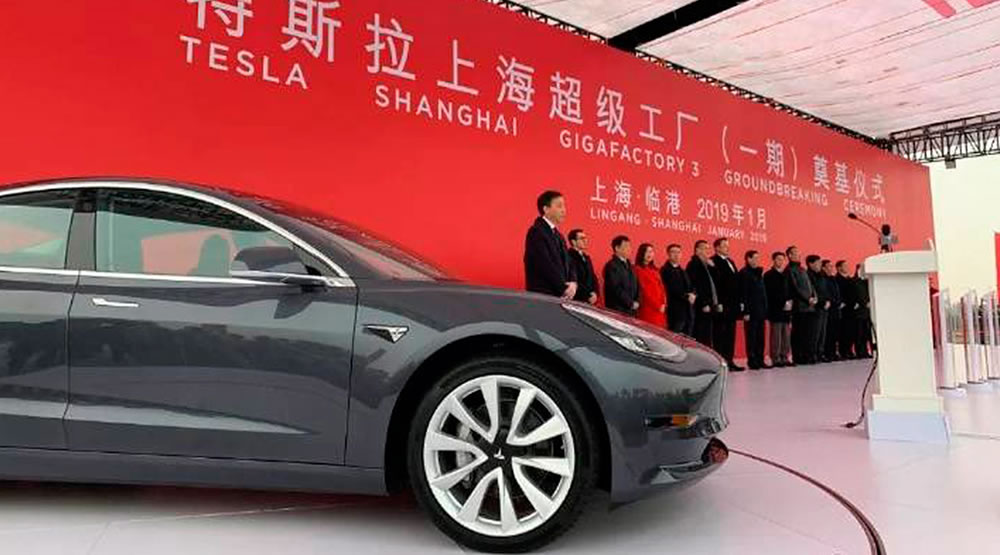
Tesla Model
3 shines in transition month
With
the Chinese market slowly returning to normal, now that China has endured the first wave of the COVID pandemic, sales started to recover from February’s
fall into the abyss, by dropping just 51%, to close to 60,000 units, a significant
improvement from the 65% fall of the previous month.
It
is expected that this recovery will develop in the coming months, with the
second half of the year probably seeing positive months, and maybe by the end
of 2020, we could see this market back in black.
As
a consequence of these events, the March PEV share was 5.7% (4.8% BEV), pulling
the 2020 share to 4.2% (3.3% BEV), a step below from the 5.5% of 2019, but this
is still the first month of the AC (After Corona) era, so we expect this number
to grow throughout the year.
One
positive sign is that BEVs are resisting better, with all-electric models
dropping 49% vs 58% for PHEVs, leading BEVs to have 84% of plugin sales last
month, in line with the 86% of last December, and pulling its 2020 share to 79%,
so the “Go BEV, or Go Home” mantra continues.
Looking
at March Best Sellers, the production ramp up is visible, with the 5-digit
performance of the Tesla Model 3 leading the surge, but the remaining Top 5
models have also seen Personal or Year Best performances last month.
Here’s March
Top 5 Best Selling models individual performance:
#1 – Tesla Model 3
The poster child for
electric mobility hit 11,280 units
(including imports), winning its third monthly Best Sellers title in a row,
winning its first 5-digit performance in China. While the absolute record is
still far - 21,963 units - BAIC’s December
record could become in danger by the sporty silhouette of the Model 3 sometime this year.
#2 – BYD Qin Pro EV
The maker’s reply to the GAC Aion S and BAIC EU-Series
has repeated February’s 2nd place last month, thanks to 5,271
units, a new record for the fully electric sedan, so it seems BYD is betting in
it to ramp up and stay among the Best Sellers, if production capacity is not a
problem, demand might be, after all, the GAC Aion S is cheaper AND has better
specs (59 kWh battery and 510 NEDC electric range for the Aion, 53kWh and 421
kms for the Qin).
#3 – BAIC EU-Series
Beijing Auto’s star sedan and last year’s Best
Selling EV in China, is starting to flex its muscles, having reached 4,450
units last month, a new year best, ramping up its new R600 (60 kWh battery, 460
kms NEDC electric range) version, in order to stay relevant in the race for
best-selling EV.
#4 – GAC Aion S
GAC’s
sleek sedan this time was left out of the podium, having registered 2,957 units,
a new year best, but that nevertheless was insufficient to win a medal, as
local Big Boys (BYD and BAIC) have started to ramp up production more swiftly. One
of the most competitive domestic EV’s on the market, the Aion S is sure to
continue a regular in this Top 5, growing with the remaining market.
#5 – SAIC MG eZS EV
The
production of the compact crossover has been ramping up, and although its
career in its domestic market has been discreet so far, with the random Top 5
presence, overseas it is a whole different story, being by far the Best Selling
Chinese EV in foreign markets, providing relevant volumes in a number of
European markets, but also leading the EV Revolution in a number of countries,
like Israel, India, Chile or Thailand. But back to China, last month it reached
a Year Best 2,531 units, allowing
it to achieve its first monthly Top 5 spot in 2020. While the MG model has a
middle of the road specs (45 kWh battery, 262 kms / 163 mi WLTP range, 110 kW
motor), it compensates with a spacious and well apointed interior. On a final
note, the secret of the success of the Sino-British EV in export markets,
regarding other Chinese OEM efforts, is that it benefits from a (somewhat)
familiar brand (MG), that is associated to British-ness, even if in practice
the Anglo-Saxon genes of the eZS are minimal, but above all, it sits in a relatively
untapped end of the market (electric compact crossovers), that in the overall
market is growing fast globally.
 |
| Li Xiang ONE |
Looking
at the 2020 ranking, there were some
significant changes, if the Tesla Model 3 cemented its leadership, below it we have
two new podium bearers, with the both the BYD Qin Pro EV and BAIC EU-Series jumping
3 positions to Second and Third place, respectively.
The
local EV Startups are starting to get a hold on the market, with the Hozon Neta
N01 joining the table, in #19, being the 4th startup model in this
Top 20, after the #9 NIO ES6, #11 Li Xiang One and #13 Weltmeister EX5. And the
XPeng G3 is not far from the Top 20 too…
Just
outside the table also we have the #21 BYD Song Pro EV, that scored a record
1,003 units last month, and is now only 31 units behind its stablemate #20 BYD
Tang PHEV. And the good news for the Shenzhen maker didn’t ended there, as BYD
also saw its small Crossover Yuan EV climb 4 positions, to #8, thanks to 2,009
units, its best result in 7 months, while the e2 hatchback (1,215 units, year
best) climbed to #15, helping the Shenzhen maker to keep its leading position
on the market.
Finally,
the MG eZS EV jumped to #6, becoming the highest standing SAIC, surpassing the
Roewe Ei5 station wagon.
Looking
at the manufacturers ranking, the current disruption is being felt, if BYD (17%,
up 2%) is keeping the leadership, below it there are seismic changes, with
Tesla (14%, up 5%) jumping to the runner up spot, while SAIC (12%, down 2%) dropped
to 3rd, with GAC and BAIC outside the podium, both with 8% share.
Another
sign of the current disruption is that Geely, the #4 brand in 2019 and the
largest Chinese maker in the overall market, this year has dropped sharply,
having just 3% share, suffering from the PHEV fall from grace (10 out of its 12
plugin models are PHEV), while its Geometry A, set to be Geely’s take on the Tesla
Model 3 recipe, is languishing in anonymity, more than 600 units below the Top
20 and selling 6 times less than the GAC Aion S.
Hell,
even the startup NIO is outselling Geely plugins…


